Financial value is external — and everything else is cost.
A startup with £100m in the bank is still running out of money. Every meeting, every experiment, every lesson learned — all of it is cost until a customer pays for something worth paying for. Financial value is generated outside the business, not inside it.
Why only one type of value is externally validated — and what that means for everything else you measure
There's a specific kind of meeting that happens when the runway starts to shorten.
The team has money in the bank — sometimes a great deal of it. The engineering is good. The experiments are running. The learning is accumulating. Decks are full of insights. Retrospectives are full of lessons. Everyone is working hard and most of them are working well. What hasn't happened yet, or hasn't happened enough, is the thing that pays for everything else — a customer choosing to pay for something the company has made. And the clock is ticking regardless.
I have sat in versions of this meeting more than once. The mood is always the same. It is not a lack of activity. It is not a lack of intelligence. It is not a lack of effort.
It is the dawning realisation that all the activity, intelligence, and effort inside the building is cost — and the only thing that will turn that cost into something else has to come from outside the building.
Editor's note — where this sits
This piece sits in the Physics layer of the Idea to Value system — the layer concerned with how investment and effort move toward value, and where cost accumulates along the way. The argument is structural, not evaluative: financial value is the only type generated externally, and that asymmetry shapes everything about how organisations should think about where they are investing their time.
For the organisational-structure consequence of this argument — what happens when the ratio of people directly creating value shifts — see The delivery ratio, a companion piece in the same layer.
The Idea to Value system — five layers
The mapDirection & orientationWhere we're going and where we are
The physicsHow ideas move to valueThe gap, the cost, the runway, the learningThis article
The wiringCommunication & meaningHow clarity moves between people
The engineHuman creative intelligenceThe conditions that let good work happen
The flywheelHabits & compounding practiceSmall actions that build lasting capability
When I talk about this in keynotes, I keep it deliberately simple, because the point is deliberately simple.
Financial value — the money that keeps the business alive — needs two things to exist.
Something worth paying for. A product, a service, an outcome, a piece of work. Something the organisation has made.
A customer willing to pay for it. Someone outside the organisation who decides the thing is worth the money they have to part with.
If either is missing, financial value does not exist. You may have something you believe is worth paying for, but if no one is willing to pay, it is still cost. You may have customers willing to pay, but if what you are selling is not worth paying for, it is still cost. Both conditions have to be met, outside the building, before money comes in.
This is the Peter Drucker point, stated in the plainest language I can find: financial value is generated externally. It cannot be manufactured by internal effort, no matter how hard or well that effort works. The money arrives from outside. What the organisation controls is whether the conditions for it are being met.
Where the money comes from, and why that matters
Most organisations quietly assume the opposite of what I have just described. They assume that financial value is something produced inside the building — through meetings, decisions, approvals, handoffs, deliverables, milestones, reports, internal products and services.
Activity is treated as inherently valuable.
A platform was built — value was created. A strategy was approved — value was created. A project shipped — value was created.
None of those things are financial value. All of them are investments of time, energy, attention, and money placed as bets that financial value might eventually appear at the other end. Some of those bets will pay off. Some will not. And the arithmetic is unforgiving about the ones that don't.
This is why the startup with £100m in the bank can still run out of money. The learning is real. The experiments are genuine. The engineering is competent. But if none of it turns into something someone outside the building will pay for — eventually, before the money runs out — the whole operation is a long, expensive accumulation of cost.
Money (externally generated), in this sense, is not the purpose. It is the proof. It is the side-effect of having made something worth paying for, and of someone outside the organisation agreeing with you. The purpose is the work — the thing worth paying for. The money is what happens when the work meets the world and the world responds.
The four types of value — and what each one is for
Financial value is one of four types of value an organisation produces. All four are real. All four are valid. But only one is generated externally, and the distinction matters enormously for how organisations should think about what they are doing.
Financial value keeps the business alive. It is money coming in from outside, because a customer chose to pay for something worth paying for. It is the only type that exists outside the organisation, and the only one that actually funds everything else.
Cost reduction keeps the business efficient. It is the value produced when the organisation finds ways to do what it already does with less waste, less friction, less rework. Entirely internal. No customer is involved in deciding that a cost has been saved.
Enablement keeps the business operating. It is the value produced by the work of keeping the lights on — compliance, legal, regulatory, security, platform stability, foundational infrastructure, the capabilities that allow the organisation to operate at all. Entirely internal.
Learning keeps the business growing. It is the value produced when the organisation knows something it did not know before — about its customers, its market, its own systems, its own assumptions. Produced through experimentation, testing, interviews, post-mortems, retrospectives, observation, honest reflection. Entirely internal.
All four are genuine value. Nobody working in enablement, cost reduction, or learning should read this and think their work doesn't count. It does. I spend time on my own accounts, on sales, on marketing, on legal — none of which directly produces something worth paying for. All of it is valid. All of it matters. And all of it is still cost, right up until a customer pays for something.
The asymmetry is this. Three of the four types are produced by internal effort alone. The organisation can declare a cost saved, a capability enabled, a lesson learned — and nobody outside has to agree. Financial value is the only type where someone outside the organisation has to agree for it to exist. Not because the others are less real, but because their reality is established inside the building, while financial value is established outside it.
Quick reference — the four types of value
The physics
Every initiative produces one of four types of value. Only one is generated externally. All four are valid — but only one funds the others.
Financial value
External ↗
A customer pays for something worth paying for. Generated outside the organisation. Keeps the business alive.
Cost reduction
Internal
Less waste, less rework, less friction in what the business already does. Keeps the business efficient.
Enablement
Internal
Compliance, legal, regulatory, security, platform stability, foundational infrastructure. Keeps the business operating.
Learning
Internal
Knowledge the business did not have before. Produced through experimentation, testing, observation, and reflection. Keeps the business growing.
The asymmetry
Three of the four types are generated by internal effort alone. Only financial value requires someone outside the organisation to agree. All four are valid value. Only one of them funds the others.
Shipping is not where value appears
A platform released but never adopted is cost. A feature shipped to users who don't know it exists is cost. Value arrives when something changes outside the system — not when delivery is declared complete.
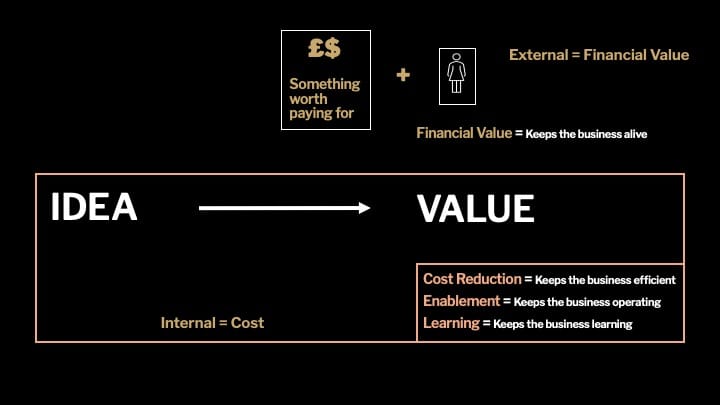
The diagram I draw when teaching this
I often sketch this live in keynotes. It is not elegant, but it does the job.
On the left, at the start, the word IDEA – everything starts with an idea.
An arrow runs across to the right, where the word VALUE sits. The rectangle is labelled internal — cost. Everything that happens between idea and value is inside the rectangle, and inside the rectangle, everything is cost.
Outside the rectangle — above and to the right. A pound sign, labelled something worth paying for. A figure, labelled customer. Where those two meet, outside the rectangle, financial value is generated. That is the moment when cost turns into revenue.
Below the rectangle, in a box, three labels: cost reduction — keeps the business efficient. Enablement — keeps the business operating. Learning — keeps the business growing. All internal. All still cost, however valuable.
That is the whole taxonomy in one drawing. The asymmetry lives in the fact that only one type crosses the boundary of the rectangle. Everything else, however worthwhile, is investment inside the system.
Everything between idea and value is cost
Once you can see the rectangle, the map of your organisation changes.
Take any idea — a product feature, a process improvement, a new capability, a change initiative, a content piece, a sales campaign. Trace its path from the moment it was first spoken to the moment value appeared — or did not.
Every step in between is inside the rectangle. Every meeting, approval, handoff, rework loop, delay, dependency, reporting cycle, governance checkpoint. All cost. Not waste by definition. Cost by nature.
The question is not whether cost exists between idea and value. It always does. The question is whether the cost is proportionate to the value at the end — and whether there are costs in the system that could be reduced or removed without affecting the value at all.
When organisations map this honestly — not the ideal version, not the presentation version, but the real one — something shifts. You can see the waiting. You can see the duplication. You can see where energy is being spent without value being created. You can see where good ideas are quietly dying somewhere between conception and completion. And you can feel it, because what you are seeing is not process inefficiency on a diagram. It is people's time. People's attention. People's effort, invested in ways that may never reach the only external test that matters.
Two examples that make the arithmetic real
The startup with the money running out is one version. Here are two others.
I have seen a team spend close to a million pounds — in consulting fees, internal time, programme overhead, and executive attention — chasing a cost reduction of roughly a thousand pound. Everyone involved was competent. The savings were real. The maths, at that ratio, made no sense. "We must reduce costs" was the mandate from on high.
Cost reduction is valid, but if it costs more to achieve than it saves, it is a cost reduction that cost a lot. The value type was real; the investment in it was not proportionate.
In the other direction, I have worked with a department of 16k people inside a 60k organisation that spent four years trying to ship a new platform. The annual run rate plus investment sat somewhere around a £250m pounds. Each year, the platform failed to reach release. The effort was sincere. The engineering was genuine. But until the platform reached customers, none of it was financial value — it was four years of accumulated cost.
When we applied the Idea to Value system to the delivery, the platform shipped in eight months. The remaining four months of the originally-budgeted year were redirected to the next project, which had been stacked in the queue unstarted for the same four years. Costs came down. Value arrived sooner. More work got done with the same headcount. The staff, for what it is worth, were visibly more engaged on the other side of it.
Both stories are the same story. Cost, however well-intentioned, is only cost until it turns into something someone outside the building pays for. The arithmetic is the same whether the numbers are small or very large.
The same arithmetic applies at every scale
This taxonomy is often mistaken for a corporate frame. It is not. The arithmetic is identical at every scale of productive human activity.
A solo creator has a runway too. It is personal savings, a part-time salary, a partner's income, or whatever else is keeping the lights on while the work is being built.
Everything the creator does — the writing, the recording, the newsletter drafts, the research, the course outlining — is cost until somebody pays for something. The creator can be learning rapidly, reducing their own friction, enabling future capacity, and still running out of money. The same two conditions apply. Something worth paying for. A customer willing to pay for it. No shortcut.
This is the thread that runs through the Solo Creator Guide — helping independent creators see their work this way before the runway runs out, because most never do, and most run out of money.
The same logic applies to a startup with venture backing, a mature business with free cash flow, a nonprofit living on grants, a consulting practice, a family business, a government function with a budget cycle. Different scales. Different clocks. Same structural fact. Financial value — or whatever equivalent resource funds the operation — is generated externally. Everything inside is cost.
Where this work comes in
The reason this taxonomy matters to me is that it is the foundation of everything I do.
My work — consulting, the Idea to Value system, the body of writing and teaching around it — is aimed at two things held in balance.
The first is shrinking the gap between idea and financial value, so that less is spent as cost on the way, and value is realised sooner. The second is cultivating a workplace that enriches the people doing the work.
Those two aims are not in tension. They reinforce each other.
An organisation that ships faster tends to have happier people, because the alternative — the four-year platform that never ships — is miserable to work on. And an organisation that treats its people as part of the system, not as variables in it, tends to ship more reliably, because the system actually works the way the diagram assumes it does.
That is the complicated side and the complex side held together. The complicated side is the machinery — process, structure, flow, measurement, the decisions about where cost accumulates and where it doesn't. The complex side is the human side — climate, meaning, trust, behaviour, the conditions in which good work happens or doesn't. Most frameworks address one half and pretend the other doesn't exist. The Idea to Value system treats both as real, because they both are.
The sixteen-thousand-person platform story sits on the consulting page as a longer case study. It is the clearest single illustration I have of what the system produces when it lands well.
The close
Money is not the purpose. It is the proof.
It is what happens when you have made something worth paying for and someone outside the building has agreed with you.
Everything else — everything inside the rectangle — is the investment that made the proof possible. The skill of running an organisation is in knowing which investments are likely to produce that proof, which are likely to produce one of the other three types of value, and which are producing no value at all. All four types are real. Only one of them funds the others.
That is the whole game. Idea to value. And once you can see the rectangle, you cannot unsee it.
Go deeper
This principle is one of 26 in the full deep dive Idea to Value system. Here's where to continue.