Effective Workplace Communication
There's a nice satisfaction that comes from being genuinely well understood at work — when the idea in your head arrives in someone else's head intact. This workbook is how you build that skill, deliberately, at your own pace.
Communication is a workplace superpower – and it can be built. A practical workbook for getting your purpose, audience and context right, so you're genuinely understood at work. The companion workbook to The Everyday Communication Workshop.
Field guide · a personal communication workbook
A personal communication workbook
Effective Workplace Communication
Effective communication is a wonderful behaviour to develop. And like all behaviours, it can be built. This is the workbook that builds it.
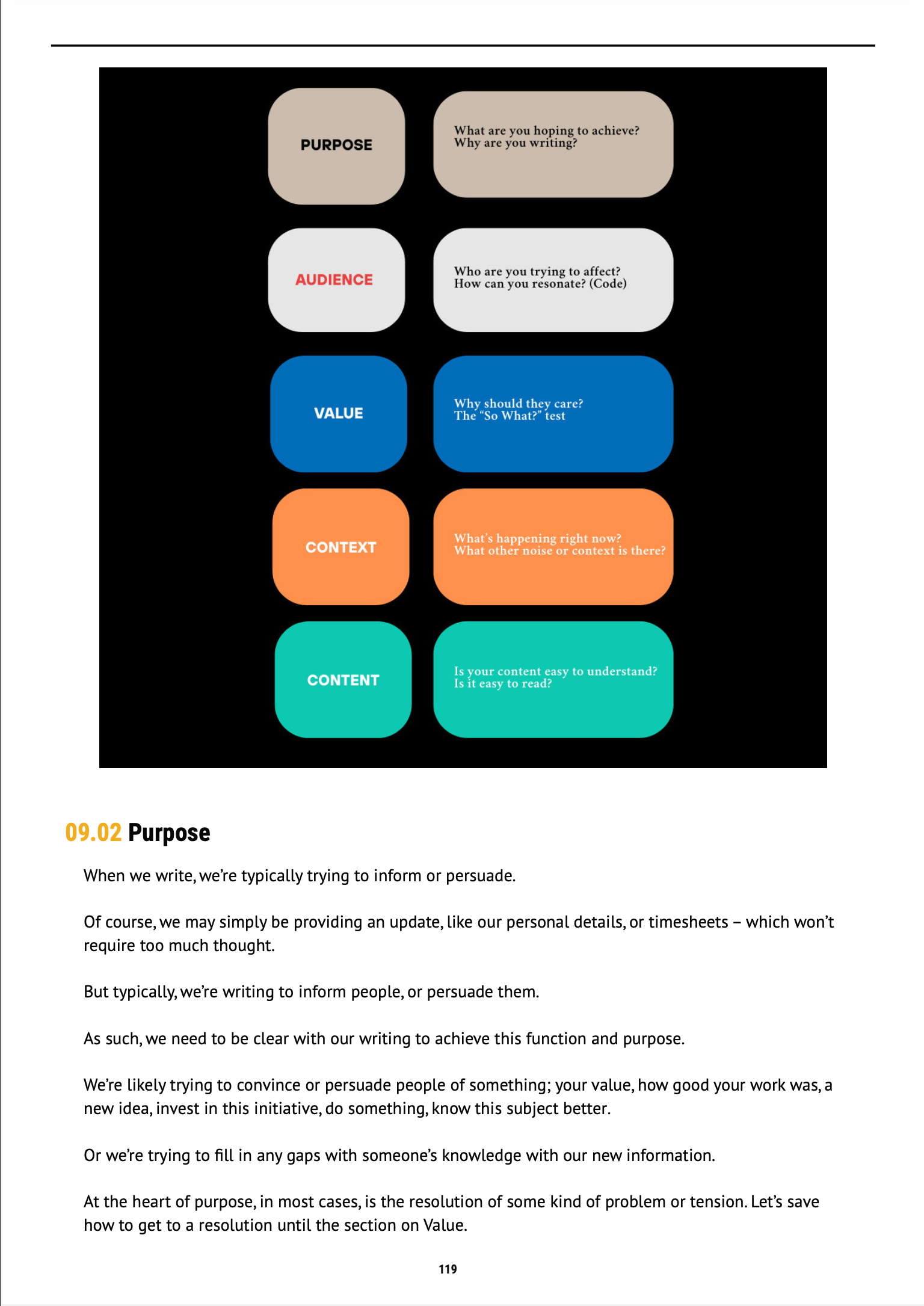
Every time you communicate, three things are in play: your purpose, your audience, and the context you're in. Get those working together and you're genuinely understood. Miss one and the message tends falls apart.
This is a practical, exercise-driven workbook for getting them right — again and again, in meetings, in writing, on your feet, and in those everyday moments at work. Plus plenty of other insights, ideas, hints and tips to elevate your messages, develop your presence and perform better in work
Rob Lambert · Winchester
Being genuinely understood is a skill you can build
A lot of good work gets lost in transit. The idea was good. The meeting was important. The email seemed perfectly clear when you hit send. The presentation seems to go well. And yet, somewhere between your head and somebody else's, the meaning dropped away and understanding wasn't created.
Most of us were never actually taught how to communicate well. We picked it up as we went along – watching parents, teachers, colleagues, bosses, friends, people on the web. We found things that worked. We found things that definitely didn't.
Eventually, we probably got by. But getting by leaves a surprising amount on the table. The meeting that goes in circles and repeats week after week. The email that lands badly and creates three hours of political wrangling. The good idea nobody really understands. The difficult conversation you keep putting off. The influence you hoped would arrive but never did. The meaning that should have travelled perfectly well, but somehow didn't make the journey.
The good news is that communication isn't a personality trait. You don't have to be naturally charismatic. You don't need to be the loudest person in the room, in fact, that's not a good move at all. And you certainly don't need to become one of those people who describes themselves as a 'strong communicator' on LinkedIn. And you don't have to put on fancy dress to be noticed.
Communication is a set of behaviours. And behaviours can be practised.
So I wrote the workbook I wish someone had handed me early in my career. It starts with a deceptively simple idea from my training in Media Science: every act of communication has a purpose, an audience and a context.
Get those three right and an awful lot starts to make sense. From there, we work through the things that make communication work in our world of work: finding your own style, reading other people, listening properly, staying calm when the pressure is on, understanding non-verbal signals, making better first impressions, writing things people actually want to read, and running meetings worth attending.
Because communication is the wiring running through almost everything we do. It carries the idea we're trying to turn into value through our actual work. It carries the decisions. It fosters the relationships. It carries our credibility at work.
But strip away all the theory and it becomes something wonderfully simple and brilliant:
being understood by the people around you – and understanding them back.
This isn't a book to read, nod at and put back on the shelf. It's a workbook. Every module gives you something to do, something to think about, and something you can keep using afterwards. There are exercises, reflections and cheat sheets designed to make the ideas stick.
Work through it properly and you'll have more than a collection of communication tips. You'll have a better understanding of how you communicate, how other people communicate, and what you can do when the two don't quite align.
Use it for good. Not evil. Although, to be fair, learning how to run a meeting properly is already a fairly powerful weapon.
What it helps you do
Turn a soft skill into a set of habits
Start from purpose, audience and context every time, and cut through the noise that tends to garble a message. Say what you mean so it lands the way you intended.
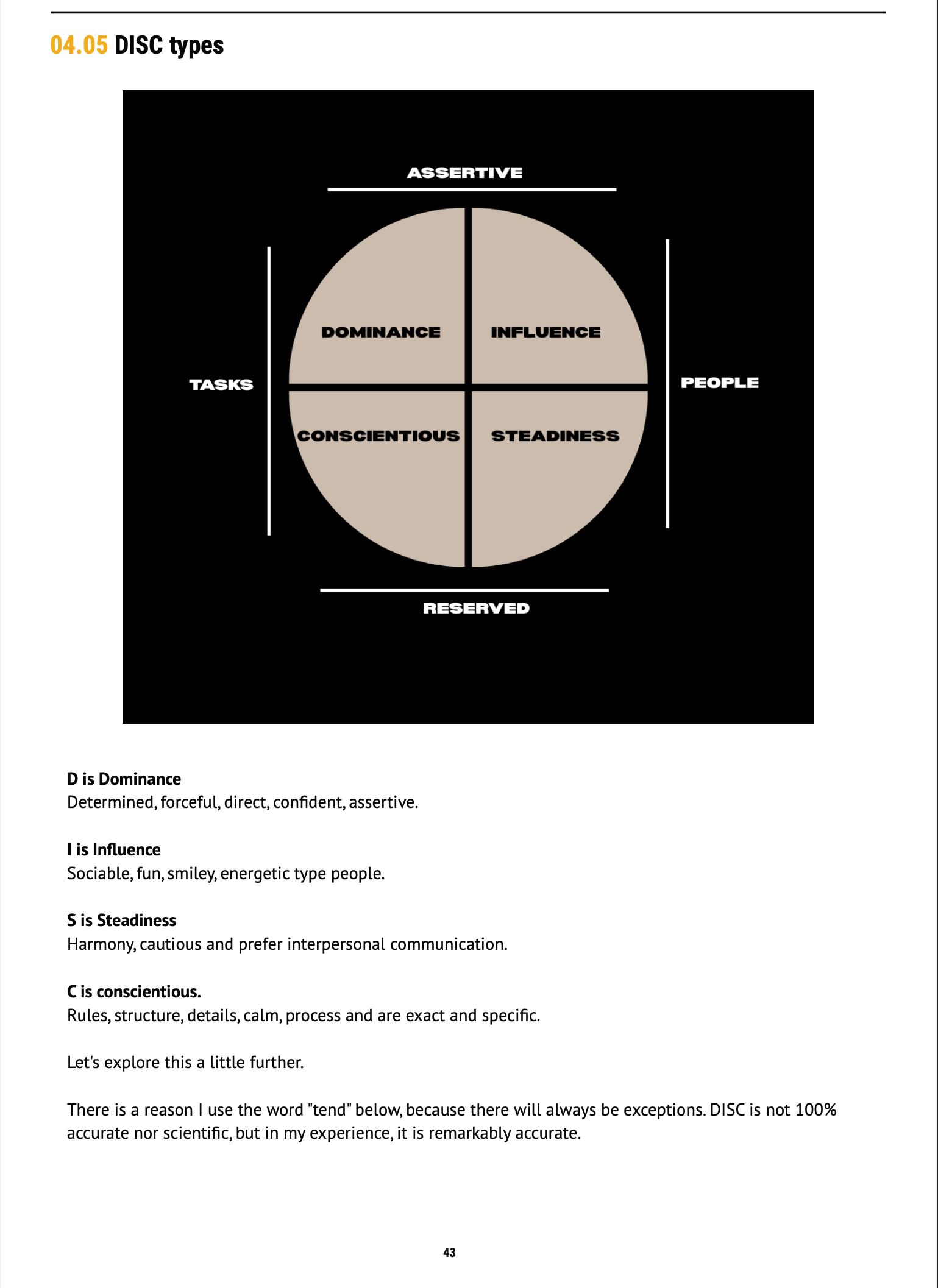
Learn your own communication style and spot others' — the drivers, the thinkers, the quiet ones — so you can meet each person where they are instead of talking past them.
Simple, tested techniques for staying calm under pressure, listening like it's a compliment, and reading the non-verbal signals people are always giving off.
A clear method for writing that gets read, and for running meetings people don't dread — agendas, ground rules, even where to sit.
The heart of it
Ten elements of great communication
Woven right through the workbook is a set of ten simple, human ideas. None of them are complicated. All of them, practised, change how people experience you.
The ten
Small ideas, practised until they're second nature.
- Be enthusiastic. Energy is contagious — it carries the message with it.
- The receiver does the communicating. It only worked if they understood it.
- Stories go where facts can't. People remember the story long after the data.
- Don't waste people's time. Respect for attention is respect for the person.
- Practice makes permanent. Rehearse the good habits, not the sloppy ones.
- People remember how you make them feel. Long after they forget what you said.
- Non-verbal is a superpower. Your body is talking whether you mean it to or not.
- People resonate with those who sound like them. Meet them in their language.
- You can hack your own state. Manage HALT — hungry, angry, lonely, tired.
- Listening is the greatest compliment. Nothing else says "you matter" so fast.
Inside the workbook
Ten modules, worked through end to end
159 pages · read, do the exercises, keep the cheat sheets
What you get
A workbook you use, not a book you shelve
- The complete 159-page workbook (PDF), instant download
- Exercises and reflection space in every module
- Cheat sheets to keep by you afterwards
- Yours to keep — lifetime access
Who it's for
Anyone who wants to be better understood at work – and to understand the people around them better. Whether you're early in your career and finding your voice, leading a team and tired of work that go nowhere, or simply someone who's realised how much smoother everything runs when communication is done well, this is written for you.
No jargon, no fluff, no theory for its own sake. Just a practical workbook, grounded in how real communication works, that you actually use.
"Communication is a superpower. And the wonderful thing about superpowers is that this one can be learned, practised, and built — a little better every day." — from the book