The Pillars of Life
Life cannot be balanced — only oriented. This essay explores the Pillars of Life: a way of looking at the tensions across the pillars that make us who we are.


Editor: Updated 15th April 2026.
The pillars build our foundations in life
There are periods in life when everything feels important at once.
Work asks for more. Family asks for more. Health reminds you that you've neglected it. The list of books beside the bed continues to grow at a rate that suggests I like buying more books than I can realistically read.
For years, I chased what people call work-life balance.
Modern life has produced a curious industry dedicated to convincing us that our greatest failure is poor diary management. Entire bookshelves are now devoted to helping us colour-code our calendars in pursuit of something called "balance."
It is an appealing idea.
It is also, I suspect, complete nonsense.
What I discovered instead is life is not a balance that has equilibrium, it is a tension that requires constant attention.
And I've come to suspect that tension isn't a sign that we're doing life badly. It's simply what happens when you care deeply about multiple things at the same time.
When It All Fell Apart
For most of my career, I built one pillar obsessively.
Work.
Productivity. Performance. Delivery.
I believed that if I achieved enough, I would eventually feel settled. Complete. But while I was strengthening that pillar, the others were quietly eroding. My health slipped. My contribution to local communities dropped. My time with friends sometimes vanished for week's on end. I told myself it was temporary. It never is. Eventually, it caught up with me.
Not a tiredness cured by a long weekend — but a collapse that forces you to question everything. My foundations had cracked.
Rebuilding From the Ground Up
At that low point, I had to ask harder questions.
What actually matters?
What must be strong if a life is to last?
Slowly, I began to define my own pillars — the foundations that needed attention if I was to stand upright over time.
What became clear is this:
The pillars are never equal.
They are always in tension.
The aim is not balance.
It is conscious choice built through paying attention.
The Six Pillars
These are the six I try to live by today. Not perfectly. But deliberately. I share them here not as an absolutely, merely as an example of what has worked in my life.
Health
I ignored this longest — and paid for it.
Health underpins everything else. Not as a moral virtue or a personal project, but as a structural reality. When it fails, nothing else can be sustained at the level it requires. Every other pillar draws on physical, spiritual and mental reserves — and reserves that are not replenished eventually run out.
Tending to health is not selfish. It is the maintenance that allows the structure to stand.
Family
Burnout forces uncomfortable clarity.
What is success worth if you have no one to share it with? My professional achievements meant very little in the period when my family saw the worst of me — the distracted, exhausted, unavailable version that high performance extracts as its price.
Family is the anchor. It is also the place that suffers first and most silently when another pillar is overloaded. The damage is slow, quiet, and cumulative — which is precisely why it is so easy to miss until it is significant.
Work and effectiveness
This was once my identity.
For years I confused effectiveness with worth. The more I delivered, the more I felt I deserved to exist. That is a dangerous equation — because the appetite for delivery is never satisfied, and the person doing the delivering eventually disappears inside the output.
Effectiveness matters. Good work matters. But work must support a life, not consume one. The pillar is necessary. It cannot be the only one.
Money and finance
Money brings stability and options.
It does not bring meaning. It is not a measure of worth, despite the signals that surround us. It is a tool — enormously useful when treated as one, and corrosive when treated as a scorecard.
The pillar matters because financial insecurity erodes everything around it. The pillar is not the point though.
Societal impact
At some point I asked: would anyone miss my work if I stopped?
Not the outputs — the actual contribution. The things made better, the people helped, the ideas that changed how someone worked or thought or led. The local community contributions?
Contribution matters. It is how work connects to something larger than delivery. It is also, I've found, one of the most reliable sources of sustained motivation — because it answers the question of why, not just how much. And it puts you in touch with other people – and human connection is the bed rock of being, well, human.
Education and learning
Learning binds the rest together.
It is how we adapt across seasons of life. How we get better at the work, at the relationships, at the management of ourselves through seasons of life. Not the accumulation of information, but the application of knowledge.
The growth in judgement, in skills, in behaviours, and in the ability to contribute something useful to whatever comes next.
This pillar is the one most easily deferred. There is always something more urgent. But the person who stops learning stops adapting — and adaptation is what allows all the other pillars to survive what life throws at them.
Living With Tension
I still do not live in balance.
Some weeks work dominates. Other weeks family does. Occasionally health demands everything.
The difference now is that I notice.
The pillars do not remove difficulty. They provide orientation. They help me place focus consciously instead of wandering so long that the repair work is life changing. They help me see where my finite resources of time, energy and attention should ideally be placed.
Orientation, Not Optimisation
Life is not a machine to be balanced. It is a structure to be supported. The work is not to eliminate tension. It is to distribute it wisely.
Because we only get one foundation.
And when it cracks, everything else follows.
Where this sits in the Atlas
Orientation·Idea to Value·Communication·Creativity & Climate·Learning
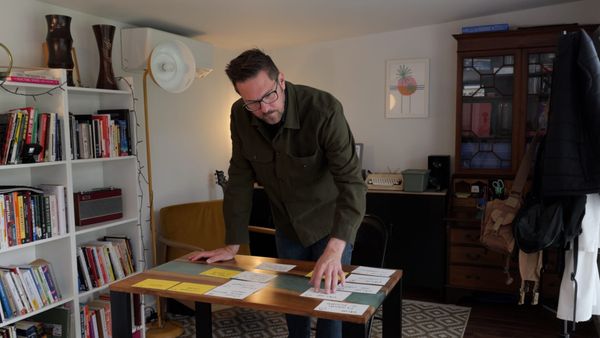
There's a video that goes with this piece, on Creative Soul Projects. Same person, same observation — just followed on camera instead of on the page.